Dedication
This book is dedicated to my father
Henry Lee Hering
a self described Genealogy Nut
COPYRIGHT
This is an unpublished version of Journey of a Thousand Ancestors. It is important not post online anywhere nor give a copy to anyone without permission of the Author.
Journey of a Thousand Ancestors, Copyright © 2026 by Lisa Hering. All rights reserved. No part of this book may be reproduced or transmitted in any form or by any means without the prior written permission of the publisher. This is a work of historical fiction. While the narrative is heavily based on the lives of real historical individuals, actual genealogy, and documented ancestral events, the dialogue, private scenes, certain characters and certain dramatic timelines are products of the author’s imagination or are used fictitiously.
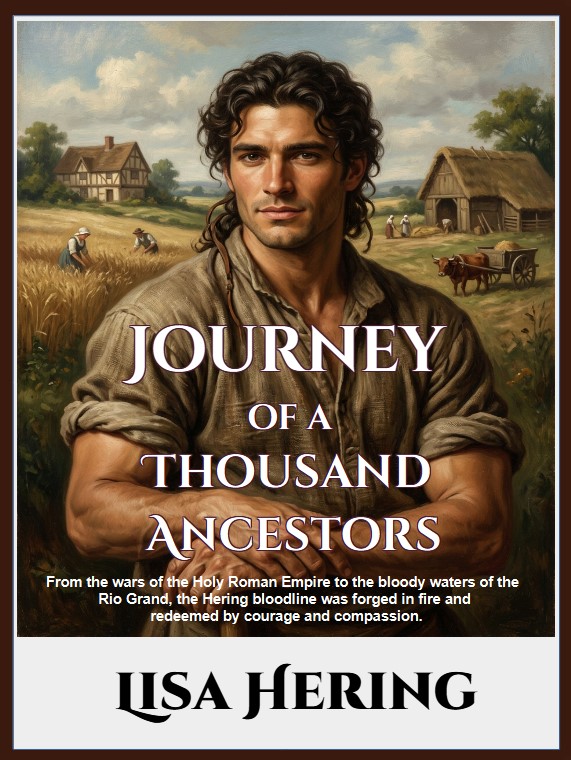
Journey of a Thousand Ancestors
A NOVEL BASED ON REAL LIVES, TRUE ANCESTRY, AND OLD FAMILY LEGENDS
BY LISA HERING
This book follows the lives of brave men and women of the Hering dynasty over the past 400 years. From the shores of the Rhine River came a mix of German and French blood, cultural opposites but the human capacity in each to work hard, protect the family, a preference for peace, but willing to heed the call to take up arms for survival. Old European laws were in effect, set up to enrich the rich and to minimize the peasant, a feudal system where it was practically impossible to to ever work your way up. For generations, the Herings competed for scarce positions of rank in a society with fixed ceilings, battling unpredictable weather, crushing taxes, and devastating wars just to protect their king’s land.
But when they crossed the Atlantic, the nature of their survival changed entirely. They left behind a world where status was dictated by force, and entered a raw, unmapped frontier where success was built purely by choice. In America, there was no pre-made system to squeeze into—they had to help invent it. Replanting their roots in Texas, their ancestral drive shifted to creation, entrepreneurialism, expanding their farms on land they actually owned, where merit was the only rank you needed. You could make your own fortune, with hard work, smart ideas, and no one ever telling you to stop.
They looked beyond the stars and said, “That’s the limit, and maybe we won’t stop there.” Armed with an unyielding dedication to honesty, moral justice, and relentless labor, they proved that true freedom isn’t about achieving high political titles, but about the right to build your own life, clear your own land, and secure your family’s destiny by your own hand. They were proud, but never boasting, quiet but never unheard, respectable but never demanding. This is the enduring spirit of their bloodline—a generational grit destined to survive for as long as mankind walks the earth.
INTRODUCTION: Courts of the Ancients
Italy, 1513
It was Niccolò Machiavelli’s sacred evening ritual to summon the ghosts of history. Every night, he marched into his library, shedding his dirty clothes for fine courtly robes. This was not a simple act of vanity; it was a show of absolute reverence. He dressed to stand in the presence of the greats. He read their books not just to scan their words, but to map their minds, deciphering both what they shouted and what they left unsaid. Through their triumphs and their tragedies, he came to know them intimately, learning to predict their next moves before they even made them. From these long-dead masters, he extracted the dark arts of strategy, defiance, and absolute power.
Machiavelli did not study the past out of academic curiosity. He did it to save his fracturing homeland. No matter his modern reputation as a villain, his raw observations have withstood five hundred years of scrutiny. Every person who steps onto the stage of modern politics walks a path he first identified and defined.
Those who dismiss Machiavelli as a mere monster fail to understand the desperation of his world. In the 1500s, Italy was being torn apart by foreign armies. The French and the Spanish carved his beloved country into helpless satellites. Machiavelli was a patriot on fire for his nation. Because he had interrogated the great leaders of antiquity—both the noble liberators and the ruthless tyrants—he held the secret keys to freedom. He had the answers because he was the only man alive who had taken the time to ask the ancestors. But the rulers of his day chose arrogance over wisdom. They fought among themselves, ignored the lessons of their forefathers, and left the immense power of history on the table. As a result, Italy remained shackled in foreign chains for another three centuries. Machiavelli may have lost Italy in his lifetime, but through his writings, he won the world.
We hold that exact same power in our hands today. We have the extraordinary opportunity to reach backward, to embrace our own bloodlines, and to breathe fire into the past. Knowledge is the single greatest asset of humanity, and it is the dead who have left us the map. By breathing new life into my own ancestors, I am not just looking backward—I am seeking a truer understanding of myself. We all stand on the shoulders of giants. By retracing the footsteps of those who came before me, I have finally learned exactly who those giants are.
PROLOGUE: A WINDOW ON THEIR WORLD
Berlin Community, New Wehdem, near Brenham, Texas
March, 1973
My father sloshed through mud-filled puddles and wet grass, his eyes locked on the weathered headstones in search of a single name. His nice black work loafers were completely soaked, but he was entirely oblivious to the rain and the chill of another ancestral quest.
“It’ll just be a couple of minutes,” he always promised before we left the house. “Why don’t you wait in the car where it’s warm?”
He routinely dismissed the long, exhausting drives and the suspicious glances of country church administrators who took down our license plate numbers as the unavoidable cost of tracking the dead. The hunt was on, and nothing else mattered.
Inside the station wagon, the windows fogged up in the cool March air. When the downpour finally paused into a drizzle, I stepped outside just to listen for him. The heavy, rhythmic squelch of his muddy footsteps was the only sound left in the world. The rest was total silence, save for the wind whistling through the bare branches. Surrounded by tombstones and rising mist, my father looked like a ghost himself—a long-lost resident taking a brief break from being dead. In those days, you couldn’t just click a button online to trace a bloodline; you had to personally comb the countryside to fill a single blank in the family puzzle.
Suddenly, his excited voice cut through the nasty weather. Neither rain nor sleet could squelch his delight.
“Here it is!” Henry Lee Hering shouted.
Even from the car, the raw emotion in his voice carried across the graveyard. He stood as a solitary silhouette, half-hidden by the mist at the far end of the property.
“What did you find?” I shouted back, pulling my coat tighter. “Is it worth my coming down there?”
The warmth of the car’s heater looked vastly more appealing than a trek through the chilling muck, even if it was for our ancestors.
“It’s not what,” he called out, his voice ringing clearly through the fog. “It’s who. I’ve found Fredericke.”
“Who’s Fredericke?” I asked ignorantly.
“Fredericke! Don’t you remember the family legend about Fredericke?”
“Well… maybe I do,” I lied, shielding my eyes from the drizzle.
“The legend is true,” he said. His voice dropped into a tone of absolute awe that reverberated across the open space. “Her in-laws are on both sides of her, and her baby is right here with her.”
At the mention of her name and the tragic arrangement of the graves, I felt a sudden, sharp pang in my chest. I didn’t remember the story—not yet—but I knew instantly that this was a moment I couldn’t witness from a distance. The comfort of the car meant nothing now. I had to see this for myself.
I stepped into the grass and began the long trudge. Every step was a battle against the heavy, sucking Texas clay. My shoes sank deep into the muck, but the magnetic pull of the mystery was stronger than the cold.
When I finally reached his side, I stared down at the three headstones resting in a row. It looked so strange—a daughter-in-law resting eternally between an old married couple. There had to be a remarkable story hidden beneath the dirt.
My father laid his hand on Fredericke’s headstone as if he were resting it on her shoulder to comfort her. But he stared past the gravestones, his gaze fixed directly on the past, walking among these people when they were alive, reliving some moment with them that had touched him. I waited in the quiet until he finally looked up at me. I didn’t even need to ask the question.
He began, “All these people boarded a ship in Germany, coming here to live a better life. But they walked right into a war torn Texas. First the Mexican-American War, and not long after, the Civil War. Andreas came as a young boy. Fredericke was his wife. She was eight months pregnant, and childbirth back then could be deadly. Andreas was forced to leave her to fight. He became a gunrunner,” my father whispered, his breath pluming in the cold air. “He worried, but his parents gave him their sacred word to surround her with their protection every single day. He had a dangerous mission to perform and needed a clear head.
He paused, looking deeply at me. “Do you feel their pain?”
“Absolutely,” I replied, the chill reaching my bones. “I do.”
“Then their voices haven’t died. They still talk,” he said, his eyes filling with a quiet, ancient sorrow. “They tried, but their promise wasn’t enough. She and the baby both died before he returned. They failed to protect Fredericke in life, so they chose to do the next best thing. The way they placed their bodies after death is a permanent message. They wanted her to know they loved her, and that she and the baby would never be alone. What happened was never forgotten. It was passed down verbally from generation to generation—from Heinrich to Charles, to my father, and to me. And now to you. Not only did we hear the legend, but we have irrefutable proof that it is true, just by walking the same path they once walked, our footprints in theirs. Don’t you wish you had known them? Don’t you wish you could have comforted them with a hand on their shoulders? Don’t you wish you could let them know they are not alone?”
I understood then that this wasn’t a stagnant hobby; it was a living, breathing recreation of life. These were not just bones—they were kinsfolk I could have loved had time morphed differently.
My father looked at me, a mischievous glint in his eye and a half-smile breaking across his face. “Dear One,” he said, using his favorite name for me, “when I finally retire one of these days, I’d like to do some traveling. I’ve gotten the addresses of the old homesteads of several ancestors, and there are lots of cemeteries and churches we could investigate. It might be rainy, but we can go back so many more generations. That’s where we find the old ones, their church records and their graves. Maybe they’ll look down upon us and know. Interested?”
He just never quit. I smiled, nodded, and confirmed with absolute finality, “Interested!”
The rain turned to a fine drizzle as we walked back to the station wagon, fairly wet and shivering, but filled with a distinct feeling that we had accomplished something monumental. It felt as if we had let them know someone still cared. I hoped someone would still care about me a hundred years after my own death.
The voices of Maria, Johann, and Fredericke lingered in our heads. It is one thing to hear a story about someone from the past, or to read their names in a faded marriage logbook next to the date of their union. It is something entirely different to touch their tombstone. It makes a real, physical connection with the people of the past—my ancients.
When you know them well enough that you can see them as more than mere bones and weathered headstones, they come to life as the living, breathing mothers and fathers, beloved sons and daughters, inspiring cousins, and fierce friends that they were. You realize they carried haunting emotions no different than ours today, running the entire human gamut from pure ecstasy to utter devastation. What a sweeping history they leave behind as they inadvertently create our collection of family legends. I cherish the walk I took with my grandmother when she admitted to me that she once stole an orange. And my quiet grandfather insisting until his dying day that the first time he saw my grandmother was when she fell off her bicycle. She denied ever doing that. The same goes for the story of the horse that reared frantically while she was driving home in a buggy, and a man appeared out of nowhere to calm the beast. She never knew who he was. He never asked for any praise or thanks. What if he knew that one act of simple kindness would outlive him? They’re all part of a huge love story.
And that is what breathing life into the ancients is really about: understanding the love story that exists underneath all the struggles and sorrow. There was always a love story. Without it, there wouldn’t be any reason to struggle or survive.
Since the 1970s, my father and I have marched through dozens of muddy cemeteries, spent months at the Mormon Genealogical Library in Salt Lake City, and risked our lives driving on the left side of the road in England just to find our ancestors. His passion has never faded, and he transferred that fire directly to me. I have passionately written the stories he recounted as we walked together through my grandfather’s Texas cotton fields. I have written much of this work through his very eyes, and that is why this book is dedicated to him. Yes, he kept his CPA certificate current until he surpassed the age of one hundred. Yes, he kept his pilot’s certification up to date well after he became a centenarian. And the hundreds, if not thousands, of drawings and watercolors he did created and gave out in his later years was cause for the recipients to cheer and see the beauty in his life. But if any one thing defines his legacy, it’s his quest to know, honor, and bring his forefathers and mothers into our lives as the people who directly and indirectly made us who we are. Each one of them is part of a puzzle that would crumble if their input wasn’t there. It’s that important.
So I watched my father as he touched various grave markers and took a few moments to consider the lives of those in the ground. And without putting a lot of thought into it, I began to do the same, sometimes rubbing the top, sometimes a finger on their name. I read out several memorable epitaphs which told me just a bit more about their life. Those that were marble were cold and smooth. Some were gritty sandstone clearly washing away. And then, a strange, unforgettable thing happened to me that rainy day in the Berlin Community graveyard.
As I knelt in front of a grave marker bearing the name Henry Hering and gently pressed my palm to his worn, faded headstone, I closed my eyes, wondering what he had looked like as a young boy growing up in Germany, and if he wore the typical leather lederhosen of the era.
I felt a sudden deep chill. When I opened my eyes, my father was gone.
In the distance, right by the edge of the dirt road, I saw a solitary figure digging in the earth. I spun around, searching for the station wagon, but the car had vanished. I turned back toward the graveyard, and many of the headstones were gone. Where they had been, the grass was untouched virgin soil. The silence was heavy except for the gardening noises made by the youngster.
Bewildered, I walked over to the young boy. He was carefully planting small green sprigs into the soil. He stopped his work and looked up at me, his eyes bright.
“Hallo,” he said, his voice thick with a German accent.
“Hello,” I replied, my heart hammering against my ribs. “Have you seen a middle-aged man walk this way?”
“Ja,” the boy nodded. “My großvater. He went that way,” he pointed directly to the empty space where our car had been parked just moments before. “He was tired, so he took the horse. But he’ll be back. Just wait here.”
“Horse?” I asked. “Horse?” I repeated in disbelief.
“Ja,” he said. “You don’t know what a horse is? You’re not German.”
I defended myself, “My ancestors were German.” I looked down at his hands. “What are you planting? And why here, in this cemetery?”
“Jasmine,” he said proudly. “Maybe some roses, too. Because,” he said, I walk past here everyday with my grossvater, and it looks very lonely. It’s a new cemetery, and there aren’t many buried here yet. It needs something.”
“New?” I asked, remembering that every grave I had seen there was put there before this century and some of the engraving so worn they were no longer readable. The boy looked at me again as if he held all the right cards. I looked up at the massive tree he was working under. They were growing scattered across the landscape, big and old, ancient, so ancient their limbs were twisted and thick, growing horizontal before curving up to the sky. They were towering above him, their thick, sprawling roots casting a deep, suffocating shade over the ground. Not even the wild grass could grow beneath them. All the trees were magnificent and ancient. Why had I not noticed them before?
“What kind of a tree is this?” I asked. The boy looked up, reading the leaves.
“It’s a post oak,” he said, matter of factly. Then he looked at me as if I was not very smart. “We use them to make posts.”
“I knew that,” I lied. “I used to make posts all the time.”
He laughed and went back to digging.
“Don’t you think it’s a bit too shady right there for Jasmine and roses?” I asked, remembering my experiment to plant all the same plants in the shade, partial shade, and sun. I would see what could survive where. I killed a lot of plants unnecessarily.
“Shady?” the boy asked, tilting his head. “No, they’ll be fine. Everyone has to make the best of wherever they are.”
“But some plants can’t grow in the shade,” I insisted.
He looked up at the old oaks, his expression stubborn. “But I need them right here by the road, where I can walk past them every morning with my großvater. I can bring a fresh rose home to my mother and pick some sweet jasmine for the kitchen. If they are planted far away, I’ll never see them. This is close to my home. I think they’ll grow.”
“What’s your name?” I asked quietly.
“Heinrich,” he said. “Heinrich Hering.”
The breath caught in my throat. “Hering? That’s my last name, too. In fact, my father’s name is Henry Hering. Henry Lee Hering.” The boy was not too impressed. I had yet to sound sophisticated.
“We’re probably cousins then,” he shrugged, entirely unmoved by the coincidence. “I’m related to almost everyone around here. And everybody has Heinrich somewhere in their name. My großvater was the Obergrebe back in Oberkaufungen. Christoph Hering. Did you know him?”
“The what?” I asked, stumbling over the word.
“You know,” the boy said, a flicker of irritation crossing his face. “The wise man. The one who tells you what to do when you get mad at someone or if you want to do something that someone else doesn’t want you to do. If you want to meet him, he’ll be back here in just a minute.”
The boy patted the dirt down around the jasmine sprig, then turned his head sharply at the sound of a loud horn followed by heavy footsteps approaching from the road. “Oh, there he is! Hallo, großvater!”
“Hallo,” a man’s deep, resonant voice boomed. “Come on, let’s go before the rain gets any worse.”
I looked to see who it was. It was my father. I turned back to where the boy was. He was gone. I looked at the graves. They were as before. standing in their silent, tragic rows exactly as they had been. I looked for the massive post oak. It was gone. My mind reeled in absolute confusion.
“Did you hear me?” he called out. “We should go.”
I stumbled toward the car, opening the door and slipping into the warmth, my hands shaking. “I did hear you… where have you been?”
“I just walked around the cemetery. I was probably just over that ridge.” he said, looking at me with concern. “You seem to be in a fog. I don’t blame you though, this cemetery is very moving.
“Moving?” I asked. “What do you mean by that?”
“Moving,” he said, “emotionally provocative, even life changing.”
“You didn’t mean like people moving around?” I asked.
“No, that’s not what I meant,” he said. “But, I could have meant that if you need it to mean that. Did you see anything unusual? Ghosts?”
“I’m afraid to tell you what I saw, dad,” I whispered. “I think it must have been one of those stages of sleep where you are so exhausted you have mini-bursts of dreams, even with your eyes open. Um, you didn’t see a little boy under that tree, that post oak, did you?”
“What post oak?” he asked. “I thought Post Oak was a street name.”
“No,” I said, “It’s more than a name. It’s a tree, a real tree, an oak, but one they make posts out of.”
“Oh,” he said, “I never thought of it that way. Interesting. Where did you learn that?
“Well,” I said, hesitating, “I saw a little boy out there, right by the… the blank space where there is room enough for a tree… for a post oak. You didn’t see him?”
“No,” my father said confidently, shifting the car into gear. “I was way across the field.”
I paused, trying to pull the strange foreign syllables from the depths of my mind. “Dad… do you know what an Ober… gr… gr…”
“Obergrebe?” he supplied instantly.
My jaw dropped. “Yes! That’s it! You know that word?”
“Sure,” he said casually, navigating the muddy exit lane. “It was the title of a very important man in German villages long ago, an honorable position for a wise and trusted member of the community. There was one in our family back in Oberkaufungen, where these people came from. Why do you ask?”
“How on earth do you know that word? It’s old German, isn’t it?”
“The only time I’ve ever heard it used was in conjunction with Christoph Hering,” my father explained. “He was the Obergrebe in Oberkaufungen, Germany, back in 1822.”
“1822?” I repeated, a cold, electric shock running down my spine. “1822? Dad… did he just happen to have a grandson named Heinrich Hering?”
My father paused, his eyes narrowing as he mentally calculated the family tree. After a moment, a look of surprise crossed his face. “Yes, he did. Heinrich came over to America when he was about…”
“Don’t tell me,” I interrupted, visualizing the exact height and face of the boy I had just spoken to in the mud. “About twelve years old?”
“Yes, that’s about right.”
I looked back out the window into the misty trees, searching for any sign of the boy, but the hills were devoid of life. I shook my head, suddenly feeling foolish. I’m imagining entire conversations with ghosts.
“The strangest thing just happened to me. I swear I just saw young Heinrich digging in the soil right here, trying to plant jasmine under that post oak tree, I mean, where one could have been, I mean, there’s nothing there now.”
“Is there any jasmine there now?” my father asked quietly.
“Don’t be silly, of course not,” I muttered.
“Well, look,” he urged, slowing the car.
I leaned across the seat and peered through the rain-streaked glass at the base of the oak tree. The tree was no longer there. It was now a sunny spot. There was indeed jasmine there. And as my eyes drifted further out, I could see there was a lot of jasmine around the cemetery. “There’s jasmine all over the place in the sun.”
A knowing, brilliant smile broke across my father’s face.
“I think you are getting sick, my girl,” he said.
“What do you mean by that?” I asked
“You’ve got the genealogy bug,” he said softly. “Just like me five decades ago. You’ll learn to talk to the ancients.”
“Who are the ancients?” I asked.
“Anyone who has gone before us who holds the knowledge we need,” my father answered, his voice ringing with a deep, ancestral authority. “I talk to them every time I open a book or a certificate or a census where their names are listed. I get lost in the records. Time flies by. I become completely absorbed in the past, in the lives of the ancients. So you see, whenever you want to ask them a question, just let your subconscious lead the way. You’ll see them. You don’t really travel anywhere in body—but suddenly, you have a perfect window into their lives. For a short period of time, anyway.”
“I want to meet Christoph,” I whispered, my fingers still tingling from the touch of the stone.
My father smiled, reaching over to turn off the car’s ignition. “Go sit under that oak tree.
“What oak tree?” I asked.
“That one right there,” he pointed. “I believe it’s a post oak.”
I looked straight at the tree. The post oak was there! My jaw must have dropped all the way to the ground. I took in a deep, exhilarating breath, my eyes were wide. I looked at my dad. “How?”
He laughed a gentle laugh, and said, “Put your back against the trunk, close your eyes, and use your imagination. I’ll wait.”
I stepped back out of the car. The rain had lifted and the sunrays were beginning to poke through the clouds. I walked over to the massive, ancient oak. I sat down among the roots, leaning my head back against the rough bark, and let my conscious mind drift away into the fog. And there was an old man, walking down a dirt road. He was a kindly looking old gentleman, and looked a lot like my father. I kept watching. He was walking with a young boy. It was Heinrich! I opened my eyes in amazement and looked at my dad with excitement.
“It’s Christoph, I’m sure of it, and he’s with the same little boy I just saw here a minute ago! This is crazy! Crazy fun! And a little crazy scary. I can see them.”
“It’s our secret,” he said. “Don’t tell anyone.”
Is it real? Is it not real? Is it just a figment of my imagination pieced together from the facts that I know about them and the rest just common sense from my own head?
He replied, “Make Carl Jung one of your ancients. Just mention Active Imagination and he’ll tell you all about it.
Between my dad’s “bug” for genealogy and Jung’s Active Imagination, I had a permanent window into the lives of all my ancestors. For years, I watched them step out of the dust of death and into the space occupied by the living, Like watching an epic movie in a darkened theater. I watched their greatest joys, and I wept through their deepest grief. They stopped being cold names carved into granite; they became flesh and blood, completely real to me.
And all I had to do to see them was breathe a little life into their memory.
“Come on, Lisa. Let’s go. The rain is going to start again and we have a window,” said my father.
“We sure do have a window,” I said. “Let’s keep it open.”